
Automatic transcription has become remarkably good. For a quick record of a meeting you attended, it’s often all you need. But “good” and “right” are different things, and for some work the difference matters a great deal.
Here’s how to decide which you need.
Where AI transcription goes wrong
Speech recognition makes the same kinds of mistakes again and again:
- Names and terms. A client’s surname, a drug name, a case citation or a product code is often turned into a common word that sounds similar.
- Who said what. Software labels voices “Speaker A” and “Speaker B”. It can split one person into two, merge two similar voices, or switch labels mid-sentence.
- Crosstalk and quiet speakers. When people overlap or someone is far from the mic, words are dropped or invented.
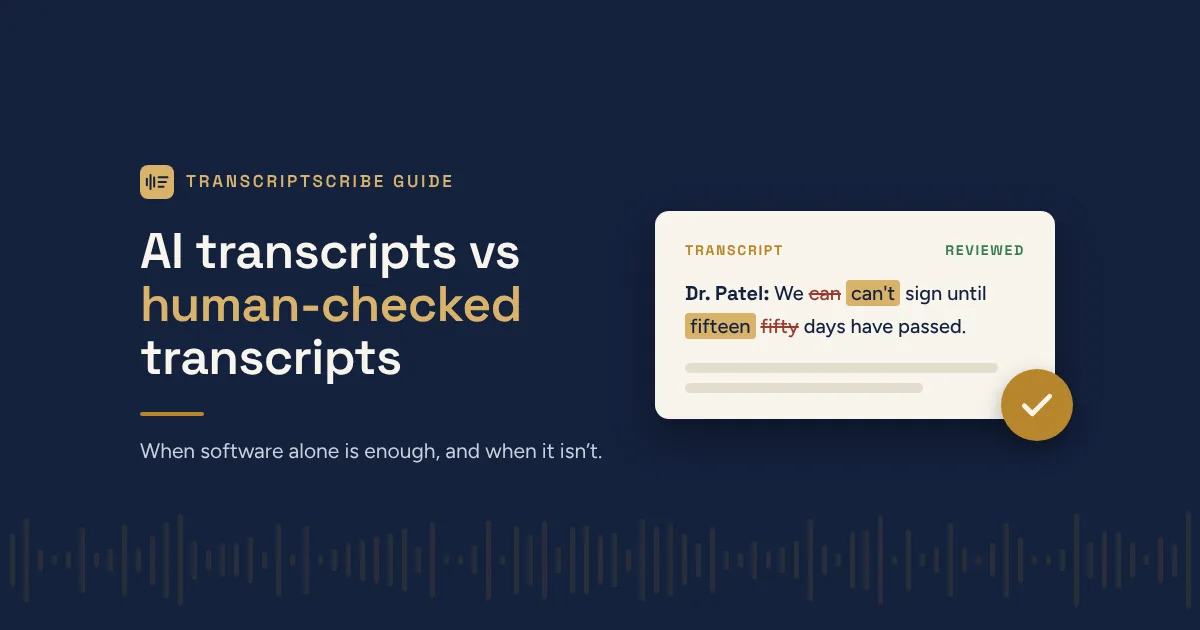
- Plausible errors. This is the real risk. An AI mistake usually reads smoothly. “Can’t” becomes “can”, “fifteen” becomes “fifty”, and nothing on the page tells you it happened.
The last point is why spot-checking an AI transcript is harder than it sounds. To be sure it’s right, you have to listen to the whole recording again.
When AI alone is enough
- Notes from a meeting you attended yourself
- Searching a long recording for a topic
- A rough first draft you’ll rewrite anyway
- Anything where a few wrong words cost nothing
When you want a person to check it
- Legal and compliance: interviews, hearings and recorded calls that may be quoted or relied on
- Research: interview data you’ll code and cite, where every speaker must be identified correctly
- Publishing: quotes in an article, show notes, captions on a public video
- Business records: board minutes and earnings calls you need to stand behind
A useful test: if someone could rely on a quote from this transcript, or if an error could embarrass you, have it checked.
What a human review actually involves
At TranscriptScribe, software produces the first draft with a confidence score for every word. A reviewer then opens the draft beside the audio. Words the software was unsure of are highlighted, so the reviewer listens closely there. They:
- correct misheard words and punctuation
- replace “Speaker A” and “Speaker B” with real names or roles
- check every name and term you listed against the audio
- fix where one speaker’s turn ends and the next begins
A second check then approves the transcript before it is released. You get the speed of software and the judgment of a person, without re-checking it yourself.
Need a transcript you can rely on? Order a transcript or read how it works.
Leave a Reply