
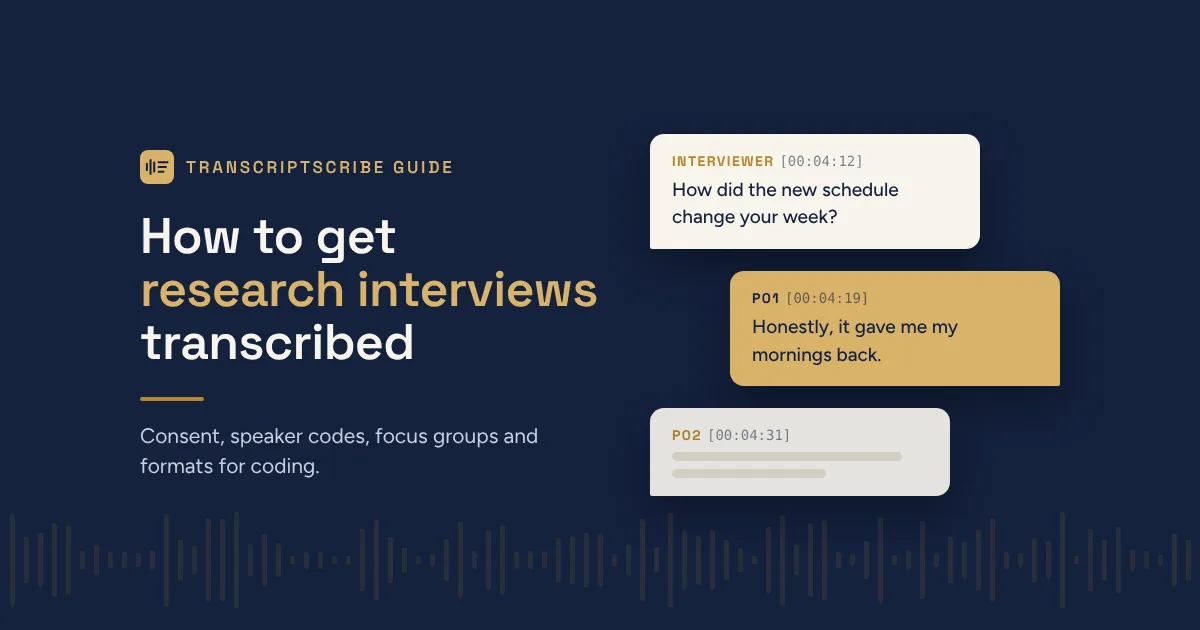
If you’re running qualitative interviews or focus groups, the transcript is your data. Errors in it become errors in your analysis. A little preparation before you send recordings out saves hours of checking later.
Before you record
- Check your consent form. Make sure participants have agreed to their recording being transcribed by a third-party service. Many ethics boards ask for this to be stated explicitly.
- Decide how participants will be named. Most studies use codes or pseudonyms (P01, P02, or “Participant A”). Decide now, so every transcript is consistent.
- Record well. A recorder close to the participant in a quiet room makes the biggest difference. See our guide to recording audio that transcribes accurately.
Focus groups need extra care
Focus groups are the hardest recordings to transcribe, because people interrupt and talk over each other. Three things help:
- Ask each person to say their participant code before speaking for the first few rounds.
- Seat people so the recorder is roughly the same distance from everyone.
- Keep a seating plan and note it alongside the recording.
When you order
Use the terms list to tell the reviewer what matters for your study:
- the participant codes or pseudonyms to use for each speaker
- the interviewer’s name or role (for example, “Interviewer”)
- specialist vocabulary, place names and organization names that will come up
The reviewer replaces the software’s “Speaker A” and “Speaker B” labels with the names you give, and checks every term on your list against the audio.
We also offer full verbatim transcription, which keeps “um”, false starts, repeated words and pauses. Many qualitative methods call for it. If yours does, say so in the terms list when you order.
Formats for analysis
- Word (.docx) imports into NVivo, ATLAS.ti and MAXQDA, with speaker names at each turn.
- Plain text works with almost any analysis tool and scripting language.
- Timestamps at each turn let you jump back to the audio when a passage needs a second listen.
Protecting participants
Recordings are stored privately and are seen only by the reviewer working on the order. Even so, avoid saying participants’ full names on tape where you can. If your ethics approval requires removing identifying details, do it on the transcript after delivery, so the original stays an accurate record. Our privacy policy explains how files are handled and how long they are kept.
Budgeting
You pay per minute of audio, and the price is shown before you pay. For a grant budget, multiply the total interview minutes by the per-minute rate on our pricing page, and choose the slowest turnaround that fits your timeline: it costs the least.
Ready to send your interviews? Order a transcript or read how it works.